Showing posts with label ninja. Show all posts
Showing posts with label ninja. Show all posts
Wednesday, September 11, 2013
Kawasaki Ninja ZX 6R

The legs started from the front and rear suspension Ninja ZX-6R can be arranged. Power and torque are spit out 128 hp and 66.7 Nm. Seat Height 815 mm, the distance to the ground 120 mm, and weighs 191 kg. ZX-6R Dimensions (LxWxH) reached 2090 mm x 710 mm x 1115 mm. Its 1400 mm wheelbase.


Move to the front brake that uses a dual semi-floating 300 mm (x t6 mm) petal discs Dual radial-mount, opposed 4-piston (aluminum), 4-pad Nissin brand. While the rear brakes single 220 mm (x t5 mm) petal disc Single-bore pin-slide, aluminum piston, Tokico.
It is equipped with fast motor electric starter will be priced at Rp230 million.

Wednesday, July 31, 2013
RADICAL MODIFICATION OF KAWASAKI NINJA

Get Free Shots
ducatimonster.files.wordpress.com/200... 


Kawasaki Ninja - a radical modification of the neat and steady for oprasional.
"It looks expensive bgt, whereas if wed be dibandingin more than Japan should modif motor, lots of crazy modif the price exceeds the price of Aprilia. but cuman doang models which all have the Aprilia Mito.Upside or down, gedhe tires, etc.. "- by Girifumi
Create crazy bro modif Girifumi assumption may be a bit much to make them mengerinyitkan forehead. But for most bikers, especially for bikers who think economically and bikers that prioritizing originality factor may very Girifumi bro assumption is correct.
Cost Factor
An example is the owner of Honda Tiger Revo (nyari safe mode-on), regardless of the cost of the average motorcycle owner modification goal was not far from the model SP NSR, Aprilia or Cagiva Mito. Even beyond the standard may modify them by replacing the light front leg into the foot upside down, the rear suspension to monshock to buy parts like fuel tank parts and the rear panel. Finally, after the modification with the cost of not less be a motor Tiger Revo is a bit like Aprilia, or SP with oddities here and there. The most severe is a radical modification of saving package style, intended to make cost savings, it is the waste and wasting time. Why? Many incidents where the motor modification costs became more expensive than the cost of buying a motor "original" that the goal of modification, is it even a strange hasilnyapun.
Originality factor
This is probably the most controversial paragraphs ever posted in INDOBIKERS. There is a question that is quite intriguing. Does the costume Barcelona numbered 14 you have to be Thierry Henry? Of course not, but certainly you have stated to anyone especially to people who see you that you are a fan or at least sympathizers of the former king of Arsenal. Bahakan if Thierry Henry "original" yes definitely saw you too will smile with you. But by installing fairing Yamaha R1 on the Tiger Revo you, and you happen to run into a real Yamaha R1 would certainly different situations. Maybe nothing happened seemingly anything but actually the driver will only R1 confusion with which you ride motorcycles, often bahakan who scorn it out in the mind of the driver R1 "authentic" is. Besides, whether by using R1 and the fairing you may be necessarily anggot club R1? Unfortunately its not going to happen but certainly you will lose motor identity.
Creativity without borders
Modifying the motor is the development of creativity without boundaries. But the best pure goal is to modify the original idea, do not imitate or trace moge existing, let alone trace CBU motor sport that costs not much (about the same cost-red) than the price of your own bike. What is clear radical modification of the motor is generally less suitable for daily use. Because like any of the conditions most appropriate motor standarlah used for daily oprasional. If still want to modify the bike but with the condition should be used as a vehicle steadily oprasional daily, the best option is to make minor modifications. Changing tires, veld handlebar and the front or Menganti sockbreaker color and striping pattern into the most appropriate choice. Good luck!
Monday, July 22, 2013
2011 Kawasaki Ninja 650 R
The nimble 2011 Kawasaki Ninja 650-R deftly combines user-friendly power and excellent handling. The 2011 Kawasaki Ninja 650-R offers serious low-end grunt boosted by digital fuel injection, light weight, and a beautiful chassis that will keep riders smiling from ear to ear whether theyre riding in the canyons or commuting on city streets. Its carefully tuned suspension complete with distinctive side-mounted shock, triple petal disc brakes and light weight make this bike a serious presence in the middle of the Ninja line.The 2011 Kawasaki Ninja 650-R slim structure is due to its compact 8-valve 649cc parallel-twin engine, which permits the use of a narrow, lightweight frame. The fuel injection and ignition settings are tuned to boost the liquid-cooled engines bottom-end torque, to smooth the low-to-mid rpm response and allow the engine to rev quicker. Routing the engine coolant internally to the cylinder and head through the engine cases reduces the number of external hoses. The engine also meets stringent emissions regulations thanks to its precise fuel injection and a three-way catalyst system with a 300-cell catalyzer. The non-intimidating twin cylinder appeals to new riders, and has an excellent mid-range that offers enough pizzazz to thrill more advanced riders. With a natural shift lever position, selecting gears is very easy. The manageable power delivery and superb roll-on response enable the Ninja 650-R to make short work of the morning commute or perform as an entertaining track day companion all while delivering good fuel economy. This spirited sportbikes frame, swingarm and suspension are all designed for minimal vibration and light, quick handling. Rubber upper-rear engine mounts in the signature trellis frame, and rubber-insulated handlebar mounts result in low vibration, for all-day comfort along with great handling. Rider and passenger footpegs are also rubber coated to reduce the amount of vibration transferred to the rider. The natural riding position and ergonomics are enhanced by a slim, low seat which makes reaching the ground easy for increased confidence. Surrounding the 2011 Kawasaki Ninja 650R chassis is unquestionably sporty styling. Avoiding unnecessary design flourishes, the Ninja 650Rs sharp lines flow throughout the bike, giving it an aggressive appearance. The fairings integrated turn signals and a sharp tail cowl highlight the motorcycles compact dimensions. From its windscreen and dual headlights to the high-quality finish of its sleek minimalist fairing, theres little room for doubt about this Ninjas supersport genetics.

Beyond its exciting appearance, MotoGP-inspired multi-function instrumentation and controls, the Ninja 650R is rolling proof that a performance motorcycle can be practical and comfortable. The rider may notice the slimness of the chassis, low seat height and minimal effort controls first before recognizing the true aim of Kawasakis design efforts the rider. The Ninja 650Rs friendly ergonomics provide a versatile cockpit that both novice and experienced riders can use to employ its fullest, from the daily commute to a weekend canyon run. In other words, this real-world overachiever easily demonstrates its versatility and everyday usefulness.
*Authentic Kawasaki Accessories are available through Kawasaki dealers.


2011 Kawasaki Ninja 650-R USA Specifications
MSRP: $7,199 USD
Engine: Four-stroke, liquid-cooled, DOHC, four-valve, parallel twin
Displacement: 649cc
Bore x stroke: 83.0 x 60.0mm
Compression ratio: 11.3:1
Cooling: Liquid
Fuel injection: Digital fuel injection with two 38mm Keihin throttle bodies
Ignition: TCBI with electronic advance
Transmission: Six-speed
Final drive: O-ring chain
Frame: Semi-double cradle, high-tensile steel
Rake / trail: 25 degrees / 4.2 in.
Wheelbase: 55.5 in.
Front suspension / wheel travel: 41mm hydraulic telescopic fork / 4.7 in.
Rear suspension / wheel travel: Single offset laydown shock with adjustable
spring preload / 4.9 in.
Front tire: 120/70x17
Rear tire: 160/60x17
Front brake: Dual 300mm petal discs with two-piston calipers
Rear brake: Single 220mm petal disc with single piston caliper
Overall length: 82.7 in.
Overall width: 29.9 in.
Overall height: 47.2 in.
Seat height: 31.1 in.
Curb weight: 449.8 lbs.
Fuel capacity: 4.1 gal.
Colors: Candy Burnt Orange / Flat Super Black,
Metallic Spark Black / Flat Super Black
Warranty: 12 months
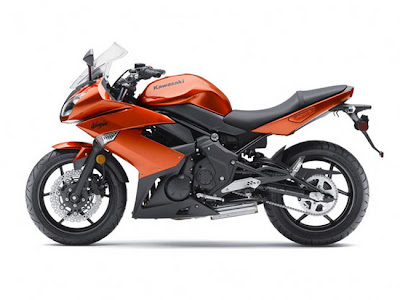
2011 Kawasaki Ninja 650-R - Canada Specifications
MSRP: $8,699 CDN
ENGINE
Type Liquid-cooled, 4-stroke Parallel Twin
Displacement 649 cc
Bore and Stroke 83 x 60 mm
Compression Ratio 11.3:1
Valve System DOHC, 8 valves
Fuel System Fuel injection: ø38 mm x 2 (Keihin)
Ignition Digital
Starting Electric
Lubrication Forced lubrication, semi-dry sump
DRIVETRAIN
Transmission 6-speed, return
Final Drive Sealed Chain
Primary Reduction Ratio 2.095 (88/42)
Gear Ratios: 1st 2.438 (39/16)
2nd 1.714 (36/21)
3rd 1.333 (32/24)
4th 1.111 (30/27)
5th 0.966 (28/29)
6th 0.852 (23/27)
Final Reduction Ratio 3.067 (46/15)
Clutch Wet multi-disc, manual
FRAME
Type Diamond, high-tensile steel
Tire: Front 120/70ZR17M/C (58W)
Tire: Rear 160/60ZR17M/C (69W)
Wheel Travel: Front 120 mm
Wheel Travel: Rear 125 mm
Rake 25
Trail 106 mm
Steering Angle (Left/Right) 32mm; / 32mm
SUSPENSION
Front: Type 41 mm telescopic fork
Rear: Type Offset laydown single-shock with adjustable preload
BRAKES
Front: Type Dual semi-floating 300 mm petal discs
Front: Caliper Dual piston
Rear: Type Single 220 mm petal disc
Rear: Caliper Single-piston
PERFORMANCE
Maximum Power 53 kW {72.1 PS} / 8,500 rpm
Maximum Torque 66 N·m {6.7 kgm} / 7,000 rpm
DIMENSIONS
Overall Length 2,100 mm
Overall Width 760 mm
Overall Height 1,200 mm
Wheelbase 1,410 mm
Ground Clearance 145 mm
Seat Height 790 mm
Curb Mass 204 kg
Fuel Capacity 15.5 L
Fuel Consumption 4.9 L/100 km (58 MPG)
DETAILS
Colours Metallic Spark Black / Flat Super Black, Candy Burnt Orange / Flat Super Black
MSRP* $8,699
Warranty 12 months
ADDITIONAL COST OPTIONS
Good Times Protection Plan 24 or 36 months (Kawasaki GTPP coverage begins after the standard limited warranty expires)
Read more »
Beyond its exciting appearance, MotoGP-inspired multi-function instrumentation and controls, the Ninja 650R is rolling proof that a performance motorcycle can be practical and comfortable. The rider may notice the slimness of the chassis, low seat height and minimal effort controls first before recognizing the true aim of Kawasakis design efforts the rider. The Ninja 650Rs friendly ergonomics provide a versatile cockpit that both novice and experienced riders can use to employ its fullest, from the daily commute to a weekend canyon run. In other words, this real-world overachiever easily demonstrates its versatility and everyday usefulness.
*Authentic Kawasaki Accessories are available through Kawasaki dealers.
2011 Kawasaki Ninja 650-R USA Specifications
MSRP: $7,199 USD
Engine: Four-stroke, liquid-cooled, DOHC, four-valve, parallel twin
Displacement: 649cc
Bore x stroke: 83.0 x 60.0mm
Compression ratio: 11.3:1
Cooling: Liquid
Fuel injection: Digital fuel injection with two 38mm Keihin throttle bodies
Ignition: TCBI with electronic advance
Transmission: Six-speed
Final drive: O-ring chain
Frame: Semi-double cradle, high-tensile steel
Rake / trail: 25 degrees / 4.2 in.
Wheelbase: 55.5 in.
Front suspension / wheel travel: 41mm hydraulic telescopic fork / 4.7 in.
Rear suspension / wheel travel: Single offset laydown shock with adjustable
spring preload / 4.9 in.
Front tire: 120/70x17
Rear tire: 160/60x17
Front brake: Dual 300mm petal discs with two-piston calipers
Rear brake: Single 220mm petal disc with single piston caliper
Overall length: 82.7 in.
Overall width: 29.9 in.
Overall height: 47.2 in.
Seat height: 31.1 in.
Curb weight: 449.8 lbs.
Fuel capacity: 4.1 gal.
Colors: Candy Burnt Orange / Flat Super Black,
Metallic Spark Black / Flat Super Black
Warranty: 12 months
2011 Kawasaki Ninja 650-R - Canada Specifications
MSRP: $8,699 CDN
ENGINE
Type Liquid-cooled, 4-stroke Parallel Twin
Displacement 649 cc
Bore and Stroke 83 x 60 mm
Compression Ratio 11.3:1
Valve System DOHC, 8 valves
Fuel System Fuel injection: ø38 mm x 2 (Keihin)
Ignition Digital
Starting Electric
Lubrication Forced lubrication, semi-dry sump
DRIVETRAIN
Transmission 6-speed, return
Final Drive Sealed Chain
Primary Reduction Ratio 2.095 (88/42)
Gear Ratios: 1st 2.438 (39/16)
2nd 1.714 (36/21)
3rd 1.333 (32/24)
4th 1.111 (30/27)
5th 0.966 (28/29)
6th 0.852 (23/27)
Final Reduction Ratio 3.067 (46/15)
Clutch Wet multi-disc, manual
FRAME
Type Diamond, high-tensile steel
Tire: Front 120/70ZR17M/C (58W)
Tire: Rear 160/60ZR17M/C (69W)
Wheel Travel: Front 120 mm
Wheel Travel: Rear 125 mm
Rake 25
Trail 106 mm
Steering Angle (Left/Right) 32mm; / 32mm
SUSPENSION
Front: Type 41 mm telescopic fork
Rear: Type Offset laydown single-shock with adjustable preload
BRAKES
Front: Type Dual semi-floating 300 mm petal discs
Front: Caliper Dual piston
Rear: Type Single 220 mm petal disc
Rear: Caliper Single-piston
PERFORMANCE
Maximum Power 53 kW {72.1 PS} / 8,500 rpm
Maximum Torque 66 N·m {6.7 kgm} / 7,000 rpm
DIMENSIONS
Overall Length 2,100 mm
Overall Width 760 mm
Overall Height 1,200 mm
Wheelbase 1,410 mm
Ground Clearance 145 mm
Seat Height 790 mm
Curb Mass 204 kg
Fuel Capacity 15.5 L
Fuel Consumption 4.9 L/100 km (58 MPG)
DETAILS
Colours Metallic Spark Black / Flat Super Black, Candy Burnt Orange / Flat Super Black
MSRP* $8,699
Warranty 12 months
ADDITIONAL COST OPTIONS
Good Times Protection Plan 24 or 36 months (Kawasaki GTPP coverage begins after the standard limited warranty expires)
Friday, July 19, 2013
 Kawasaki Ninja ZX-6R 2005
 Thursday, July 18, 2013

Monday, July 15, 2013
Kawasaki Ninja ZX RR History of The ZX RR
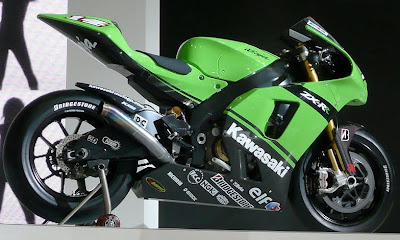
Kawasaki Ninja ZX-RR is a race bike from Kawasaki, Which was raced in the MotoGP world championship. The bike made its debut Towards the end of the 2002 MotoGP season with the Australian rider Andrew Pitt.
In 2004, Shinya Nakano joined the team and managed to get ZX-RRs first podium with a third place at the Japanese Grand Prix. In 2005, Olivier Jacque scored a second place at the Chinese Grand Prix. The next year Nakano finished second at the Dutch TT. In 2007, Randy de Puniet scored a second place at the Japanese Grand Prix. In 2008, it was ridden by John Hopkins and Anthony West.
The ZX-RR struggled in 2008, with the best results being two fifth place finishes in Portugal from John Hopkins and Anthony West in Brno. Hopkins and West blamed both a lack of feeling in the front end and rear traction on corner exit. Previous ZX-RRS have been Difficult to ride, but beyond the limited statements by the riders it is unclear what the problems with the 2008 bike Were.
At the end of the 2008 season, Kawasaki Announced its retirement from the MotoGP world championship.
In 2004, Shinya Nakano joined the team and managed to get ZX-RRs first podium with a third place at the Japanese Grand Prix. In 2005, Olivier Jacque scored a second place at the Chinese Grand Prix. The next year Nakano finished second at the Dutch TT. In 2007, Randy de Puniet scored a second place at the Japanese Grand Prix. In 2008, it was ridden by John Hopkins and Anthony West.
The ZX-RR struggled in 2008, with the best results being two fifth place finishes in Portugal from John Hopkins and Anthony West in Brno. Hopkins and West blamed both a lack of feeling in the front end and rear traction on corner exit. Previous ZX-RRS have been Difficult to ride, but beyond the limited statements by the riders it is unclear what the problems with the 2008 bike Were.
At the end of the 2008 season, Kawasaki Announced its retirement from the MotoGP world championship.
Wednesday, July 10, 2013
Kawasaki Ninja ZX 14 2010
New Ninja brother came out of hiding, as the company unveiled Kawasaki ZX-14, which costs 15 399 dollars, and the bike is designed for those who think that the power of the previous version of Ninja ZX-10R is not enough.
Kawasaki Ninja ZX-14 2011 defies Suzuki Hayabusa, powered by a four-cylinder 352cc DOHC, coupled with six-speed gearbox, with a drive to the rear axle, wheel 190/50 ZR17.
Thorough accuracy of power and torque of the giperbayka not as important as it proves its superiority on any track. The only thing that is known is that for each piston has its own brake pad, thereby decreasing heating, thereby increasing braking performance. In his new Kawasaki brake system called KIBS - Kawasaki Intelligent anti-lock Brake System, which collects extensive information from the wheels, including the speed, thrust, position, etc.
Body Ninja ZX-14 designed with wind tunnel tests, including front and rear direction indicators.
The toolbar includes a multi bikes LCD display, odometer, fuel indicator, clock, analog speedometer and tachometer.
Specifications Kawasaki Ninja ZX-14 2010:
• Engine: Four-stroke, liquid-cooled, DOHC, four valves per cylinder, inline
• Capacity: 1.352 cm3
• Bore x stroke: 84.0 x 61.0 mm
• Compression ratio: 12.0:1
• Fuel system: DFI, 44mm, Mikuni
• Ignition: TCI
• Transmission: 6 speed
• Final drive: chain
• Tilt / trail: 23 * / 94 mm
• Front tire: 120/70 ZR17
• Rear tire: 190/50 ZR17
• Wheelbase: 1460.5 mm
• Front suspension / travel: 43mm inverted fork, 13 degrees of regulation in compression and 11 to restore / stroke - 118 mm
• Rear suspension / travel: gas shock / stroke - 122 mm
• Front brake: a pair, 310-mm discs, 4-piston calipers
• Rear brake: 250 mm disc, caliper with 2 pistons
• Overall Length: 2169 mm
• Overall Width: 760 mm
• Overall height: 1171 mm
• Ground clearance: 125 mm
• Seat height: 800 mm
• Weight: 257 kg
• Fuel tank: 22 l
Read more »
Kawasaki Ninja ZX-14 2011 defies Suzuki Hayabusa, powered by a four-cylinder 352cc DOHC, coupled with six-speed gearbox, with a drive to the rear axle, wheel 190/50 ZR17.
Thorough accuracy of power and torque of the giperbayka not as important as it proves its superiority on any track. The only thing that is known is that for each piston has its own brake pad, thereby decreasing heating, thereby increasing braking performance. In his new Kawasaki brake system called KIBS - Kawasaki Intelligent anti-lock Brake System, which collects extensive information from the wheels, including the speed, thrust, position, etc.
Body Ninja ZX-14 designed with wind tunnel tests, including front and rear direction indicators.
The toolbar includes a multi bikes LCD display, odometer, fuel indicator, clock, analog speedometer and tachometer.
Specifications Kawasaki Ninja ZX-14 2010:
• Engine: Four-stroke, liquid-cooled, DOHC, four valves per cylinder, inline
• Capacity: 1.352 cm3
• Bore x stroke: 84.0 x 61.0 mm
• Compression ratio: 12.0:1
• Fuel system: DFI, 44mm, Mikuni
• Ignition: TCI
• Transmission: 6 speed
• Final drive: chain
• Tilt / trail: 23 * / 94 mm
• Front tire: 120/70 ZR17
• Rear tire: 190/50 ZR17
• Wheelbase: 1460.5 mm
• Front suspension / travel: 43mm inverted fork, 13 degrees of regulation in compression and 11 to restore / stroke - 118 mm
• Rear suspension / travel: gas shock / stroke - 122 mm
• Front brake: a pair, 310-mm discs, 4-piston calipers
• Rear brake: 250 mm disc, caliper with 2 pistons
• Overall Length: 2169 mm
• Overall Width: 760 mm
• Overall height: 1171 mm
• Ground clearance: 125 mm
• Seat height: 800 mm
• Weight: 257 kg
• Fuel tank: 22 l
Monday, July 8, 2013
Motorsports Kawasaki Ninja ZX9R Black
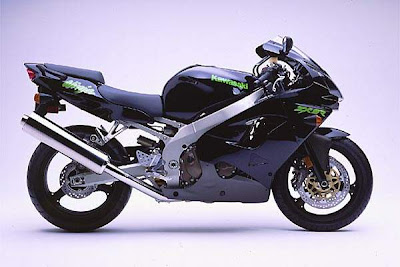
Motorsports Kawasaki Ninja ZX9R Black: Motorcycle Kawasaki Ninja>> Motorsport Kawasaki Ninja
 PR: wait...
 LD: wait...
 I: wait...
 Rank: wait...
 C: wait...
Subscribe to:
Posts (Atom)